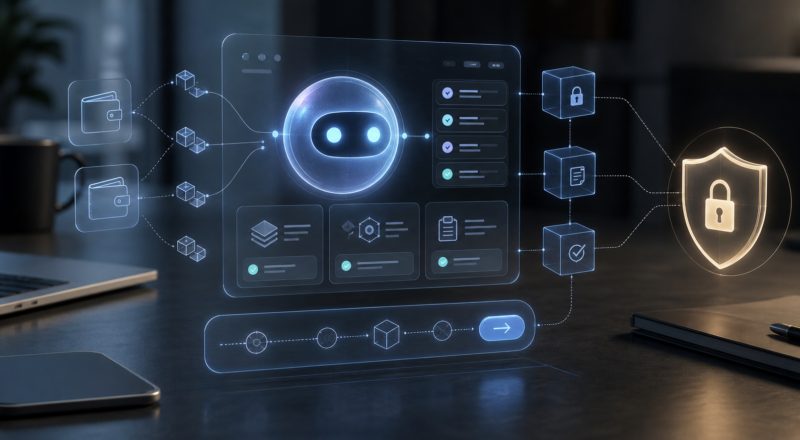
AI agents are moving from chat windows into workflows that can observe data, make decisions, and trigger actions. In crypto, that shift matters because blockchains already offer programmable money, open market data, smart contracts, wallets, and settlement rails. Put those pieces together and an agent can do more than summarize a portfolio. It can help prepare transactions, monitor risk, rebalance positions, route swaps, or manage game and creator economies with fewer manual steps.
That possibility is exciting, but it also raises a serious question: how much authority should software have over assets that can move instantly and irreversibly? The useful answer is not to give an agent unlimited control. The useful answer is to design narrow permissions, clear approval gates, and strong monitoring, so automation assists the user instead of replacing judgment.
What an AI crypto agent actually does
An AI agent is software that can work toward a goal using tools. A basic bot follows predefined rules. A more capable agent can interpret a request, call data sources, compare choices, generate a plan, and ask another system to act. In crypto, those actions might include checking wallet balances, reading smart-contract states, scanning lending positions, watching liquidation thresholds, or preparing a transaction for human approval.
The difference is the feedback loop. A portfolio dashboard shows information. An agent can decide that information requires attention, draft a response, and keep monitoring the result. For example, it might notice that collateral is becoming risky, suggest adding margin, and prepare the transaction details. The human should still review the final action.
Why blockchains fit agent workflows
Crypto networks are unusually friendly to agents because they expose data and actions through public infrastructure. Wallets, decentralized exchanges, lending markets, bridges, staking systems, and token contracts can be read by software. Smart contracts also make many rules visible in code rather than hidden inside a private database.
This does not mean the systems are simple. Agents need reliable price data, safe contract interactions, strong key management, and protection against malicious prompts or spoofed websites. The same openness that makes automation possible also makes mistakes expensive.
Examples from the AI-agent sector
The AI-agent crypto category has become visible enough to have dedicated market groupings. CoinMarketCap identifies Artificial Superintelligence Alliance with the FET symbol and tags it with AI agents, generative AI, Web3, and related categories. It also identifies Virtuals Protocol with the VIRTUAL symbol and tags it with AI agents, gaming, Base ecosystem, Solana ecosystem, and AI-agent launchpad themes.
These examples show the range of the sector. Some projects focus on AI infrastructure and open networks. Others focus on agents as digital characters, game participants, launchpad assets, or social applications. A reader should not assume that every AI-agent token captures the same type of value or risk.
Permission design is the core issue
The central challenge is not whether an agent can click buttons faster than a person. It is whether the system can limit damage when something goes wrong. Good agent design starts with scoped wallets, spending limits, approved contract lists, transaction simulation, and human approval for sensitive actions. It should also separate observation from execution. Reading balances is low risk. Moving funds, approving token allowances, borrowing against collateral, or interacting with unfamiliar contracts is high risk.
Teams also need logs and kill switches. If an agent has recurring authority, the user should be able to see what it did, why it acted, and how to stop it immediately. Without that visibility, automation becomes a hidden operational risk.
Practical use cases to watch
The most realistic near-term uses are assistant-like rather than fully autonomous. Agents can summarize portfolio exposure, flag lending or staking changes, prepare tax records, monitor governance proposals, compare gas costs, or draft transactions for review. More advanced systems may manage treasury rules for on-chain organizations, coordinate liquidity across venues, or run in-game economies where assets are small and permissions are controlled.
For individuals, the best starting point is low-stakes automation. Let agents monitor, explain, and prepare. Be cautious before allowing them to sign.
Key takeaways
- AI agents can combine market data, wallet data, and smart-contract tools into active crypto workflows.
- The safest designs keep permissions narrow and require human review for asset-moving actions.
- AI-agent tokens and platforms vary widely, so sector labels are not enough for due diligence.
- Key management, transaction simulation, logs, and kill switches are essential safeguards.
- Automation can improve attention and speed, but it should not remove responsibility from the asset owner.